ethereum difference bitcoin

At CES this past January, IBM researcher Veena Pureswaran described the company’s joint plan with Samsung to get home appliances to exchange cryptocurrency with one another.The currency, called Ether, is similar to bitcoin, except that the traded commodity isn’t directly related to a financial value.Instead, Ether’s value is computing power.What distinguishes the Ether and bitcoin cryptocurrencies from traditional money is the online system that records their every trade.Networks of people called miners use the software to collectively verify and record these cryptocurrencies’ every trade.Like ever-growing strands of DNA, the currencies’ digital addresses, called blockchains, store the details of each trade.Bitcoin and Ether run on their own software platforms, but in both cases, a blockchain makes the whole idea possible.Letting connected devices barter computing power in the Ether cryptocurrency would address a basic issue of the coming Internet of Things era: paying for the cloud services that will allow devices to do useful things and talk to each other.

Instead of relying on ads, fees from paying users, or selling data to third parties, hardware makers could use Ether as the basis for device-to-device communications and transactions.Ether would blanket all of a connected home’s devices in a network of code to minimize computing costs, reduce the scale of operation, maximize device longevity, and guarantee consumer privacy for all stakeholders in a connected future.In short, Ether could be the Internet of Things’s wonder drug.The Blockchain’s EvangelistThe company that is helping IBM and Samsung bring connected objects into Ether is Ethereum.Founded in 2014 by a group of bitcoin enthusiasts–including a 2014 Thiel Fellow named Vitalik Buterin–Ethereum is promoting a more widespread use of blockchain technology: blockchain applications for everything.Using Ethereum’s platform, coding a blockchain application should be as easy as creating a webpage in HTML.Ethereum has built an open-source software platform that any coder can use to write blockchain-based applications.
Additionally, anyone can join Ethereum’s network and offer up a computer’s computing power to the network.Then, the applications that are built on Ethereum’s software platform run on the collective power of all the computers that have joined Ethereum’s network, rather than in one centralized datacenter.
bitcoin to litecoin rateEthereum’s chief communications officer, Stephan Tual“Basically, what we’re doing is building the world’s biggest computer,” says Stephan Tual, Ethereum’s chief communications officer.
bitcoin new orleansHe imagines a scenario where more and more people will volunteer their desktops’ computing power to run programs that were built on Ethereum’s software platform.For Tual, the premise behind evangelizing the blockchain isn’t to dissolve a centralized source of power for political reasons, like Bitcoin was conceived to do; it’s to help businesses save the money and effort they would need to run these Internet of Things applications in the cloud.
bitcoin marketplace script
Ethereum is making the blockchain a reality for some of tech’s biggest players.“What Ethereum offers is really making it easy to build this stuff without needing to worry about cryptographic principles that are, quite frankly, obscure for most developers,” says Tual.The number of computers–and computing power–on Ethereum’s network is growing.A Really Slow, Really Big ComputerThere are applications that don’t lend themselves to blockchains, such as playing video games or running other applications that require similarly substantial computing resources.
bitcoin mozambique“Ethereum is a really slow computer.
ethereum speedIt’s a very big computer that always tells the truth, which is quite interesting, and also has no downtime, which is another cool property it has.
setup bitcoin atm
But it is pretty slow, compared to your laptop, for example.Because it’s the lowest common denominator that determines how fast it’s going to run,” Tual says.But blockchain technology is perfect for simple tasks that need to run constantly.Connected devices that perform crude, repetitive tasks, like monitoring temperature or turning lightbulbs on and off, would benefit the most from the blockchain’s peer-to-peer networking.IBM and Samsung have employed Ethereum in their joint Internet of Things project called ADEPT, which stands for Autonomous Decentralized Peer-to-Peer Telemetry.Along with Ethereum, the companies plan to use two other peer-to-peer applications in the project: Telehash for inter-device messaging and BitTorrent for inter-device file sharing.Ethereum will execute code between the devices.“The reason that they need this stuff is that they don’t want to pay,” Tual says, laughing.They don’t want to pay for its maintenance.” Mist, a graphical user interface for Ethereum’s software platform.Ether’s ValueEthereum’s network of computers is growing every day, as members are rewarded with CPU power for breathing life into Ethereum’s web of applications.And the Ether cryptocurrency holds clear financial value to the people who are developing the Ethereum platform.
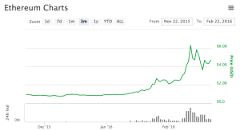
Last summer, the company made $18 million on a pre-sale of Ether.That money now pays the salaries of Ethereum’s London-based management team, as well as its 30 developers in Berlin and Amsterdam.While Ethereum will eventually spend that initial pre-sale fund, Tual hopes the company will reap the rewards of the foundation he says it’s currently laying for the Internet of 20 years from now.He says that Ether will most likely always be associated with a monetary value as long as humans develop the code for the blockchain applications.So long as there is demand to run these applications, Ether’s supply of available computing power will be valuable.ADePT’s live demo at CES 2015If ADEPT becomes reality, connected gadgets will also govern how much Ether their code will merit.“In doing so, devices can become revenue-generating opportunities in their own right,” IBM’s Pureswaran says.Ethereum is a decentralized platform that runs smart contracts: applications that run exactly as programmed without any possibility of downtime, censorship, fraud or third party interference.
Ethereum uses a public blockchain similar to Bitcoin, but also enables advanced programmable transactions types.Ether (ETH) is the primary currency on the Ethereum network.Much like bitcoin (BTC), it is created by computerized mining.Ether can be sent from one address on the Ethereum network to another, and can also be used in other transactions called ‘Smart contracts’’ Ethereum was proposed by Vitalik Buterin in a white paper.Since then many people have contributed work to the project.GDAX provides order books for both ETH/BTC and ETH/USD.You can create an account on GDAX to buy and sell ether with bitcoin, or US dollars.Bitcoin was conceived as a "A purely peer-to-peer version of electronic cash", focusing on payments, and value transfer as its primary applications.Ethereum extends the ideas Bitcoin is built on in order to provide a more generalized computational platform.This enables the creation of smart contracts, decentralized applications, and even decentralized governance applications.
Bitcoin and Ethereum are separate protocols, and it is not possible to complete a transaction from one to the other.However, you can buy and sell ether and bitcoin separately.Unfortunately if you send ether to an incorrect address, it may be lost forever.Ethereum network addresses do not have the safety measures, so it is possible to lose ether if you enter an address incorrectly.Bitcoin addresses have built-in verification to prevent errors like this.A smart contract is an executable program stored on the Ethereum blockchain.The execution of a smart contract is processed by miners, and requires a payment of ether in order to fund the processing of the contract.One or more parties can create or fund a smart contract, which will execute according to the inputs it receives.You can think of smart contracts are like a legal contract in that they specify an agreement for the handling of a given situation which may arise in the future, for example an insurance contract specifies the payout to the insured in the event of an accident.

Smart contracts differ from traditional legal contracts in that their execution is not subject to the interpretation of human institutions.A DAO is a type of contract that enables agents to purchase shares, and collaborate in the management of an organization by voting.Supporting this deposit type presents unique technical challenges and we are unable to recover ether deposited to your GDAX account in this way.We may support this in the future.In the meantime, you can deposit ether on GDAX from any standard ethereum address.At this time we do not support the functionality required to send funds to smart contracts directly from your GDAX account.This includes smart contracts like DAOs.GDAX is not a general purpose Ethereum wallet.When ether is sent to the receiving address for a DAO or other smart contract, tokens representing ownership are normally returned, however GDAX does not support retrieving assets other than ether which are sent to your GDAX account address.We may consider supporting other assets built on Ethereum in the future.
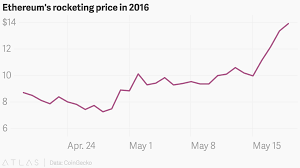
Like bitcoin, or any asset, ether has a value which can be used to trade for other assets, or good and services.Unlike Bitcoin, the development of Ethereum commerce has not been emphasized as a use case, and relatively few merchants accept ether.Although Ethereum has yet to have any major security flaws discovered, Ethereum is a young project, and loss of funds is a risk with the use of the Ethereum network in general.The Ethereum Foundation's legal agreement lists a number of these risks.The majority of ether and bitcoin deposited to GDAX is held in highly secure cold storage.It is also necessary to hold some digital currency in a "hot wallet" in order to provide fast access to withdrawals for customers.The total balance of bitcoin & ether in the GDAX hot wallets is insured against hacking and theft There are currently slightly more than 80 million ether in circulation, most of which was created during the initial crowd sale, prior to the launch of the Ethereum network.New ether is created and issued to miners at a rate of 21 million per year.