bitcoin block confirmation

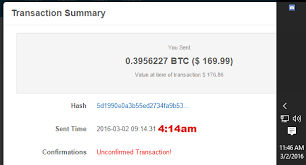
Jump to: , After a transaction is broadcast to the Bitcoin network, it may be included in a block that is published to the network.When that happens it is said that the transaction has been mined at a depth of 1 block.With each subsequent block that is found, the number of blocks deep is increased by one.To be secure against double spending, a transaction should not be considered as confirmed until it is a certain number of blocks deep.Contents 1 2 3 4 The classic bitcoin client will show a transaction as "n/unconfirmed" until the transaction is 6 blocks deep.Merchants and exchanges who accept bitcoins as payment can and should set their own threshold as to how many blocks are required until funds are considered confirmed.When potential loss due to double spending as nominal, as with very inexpensive or non-fungible items, people may choose not to wait for a transaction to be confirmed, and complete the exchange as soon as it is seen on the network.Most exchanges and other merchants who bear the risk from double spending require 6 or more blocks.

There is nothing special about the default, often-cited figure of 6 blocks.It was chosen based on the assumption that an attacker is unlikely to amass more than 10% of the hashrate, and that a negligible risk of less than 0.1% is acceptable.Both these figures are arbitrary, however; 6 blocks are overkill for casual attackers, and at the same time powerless against more dedicated attackers with much more than 10% hashrate.[1]Freshly-mined coins cannot be spent for 100 blocks.It is advisable to wait some additional time for a better chance that the transaction will be propagated by all nodes.Some older bitcoin clients won't show generated coins as confirmed until they are 120 blocks deep./~greg/attack_success.html) can be used to calculate the probability of a successful doublespend given a hashrate proportion and number of confirmations.Note that in the reality of bitcoin mining today, many more than 6 confirmations are required.(60 confirmations to have <1% odds of succeeding against an entity with 40% hash power) Each additional confirmation is a new block being found and added to the end of the blockchain.

Miners create blocks by solving the proof of work for their proposed block.The block interval has an average of 10 minutes but not every block interval is exactly 10 minutes.
bitcoin armory is offlineIt follows a statistical process known as a poisson process, where random events happen with the same probability in each time interval.
bitcoin crash february 2014Another way of expressing this is that the mining process has no memory, at every second a block has the same chance of being found.
bitcoin empty blocksPoisson processes are well-understood but can be unintuative.
bitcoin conference washington dcThere are lots of block intervals with a time less than 10 minutes but then a few block intervals much longer which bump up the average to 10 minutes.
ethereum reddit mining
So the bitcoin network can get unlucky and a block won't be found for a whole hour.In a 10 minute interval, the probability of a block being found is about 63% (or 1 - e^(-1)).
easy litecoin walletSo approximately two-thirds of the time a block will be found in 10 minutes or less.
bitcoin betting botIn 30 minutes a block has a 95% chance of being found, which rises to 99.7% if the time interval is 60 minutes.
ethereum tutorial javaLast updated: 20th March 2015 Bitcoin transactions are sent from and to electronic bitcoin wallets, and are digitally signed for security.
bitcoin takEveryone on the network knows about a transaction, and the history of a transaction can be traced back to the point where the bitcoins were produced.

Holding onto bitcoins is great if you’re a speculator waiting for the price to go up, but the whole point of this currency is to spend it, right?So, when spending bitcoins, how do transactions work?Here’s the funny thing about bitcoins: they don’t exist anywhere, even on a hard drive.We talk about someone having bitcoins, but when you look at a particular bitcoin address, there are no digital bitcoins held in it, in the same way that you might hold pounds or dollars in a bank account.You cannot point to a physical object, or even a digital file, and say “this is a bitcoin”.Instead, there are only records of transactions between different addresses, with balances that increase and decrease.Every transaction that ever took place is stored in a vast public ledger called the block chain.If you want to work out the balance of any bitcoin address, the information isn’t held at that address; you must reconstruct it by looking at the blockchain.If Alice sends some bitcoins to Bob, that transaction will have three pieces of information: To send bitcoins, you need two things: a bitcoin address and a private key.

A bitcoin address is generated randomly, and is simply a sequence of letters and numbers.The private key is another sequence of letters and numbers, but unlike your bitcoin address, this is kept secret.Think of your bitcoin address as a safe deposit box with a glass front.Everyone knows what is in it, but only the private key can unlock it to take things out or put things in.When Alice wants to send bitcoins to Bob, she uses her private key to sign a message with the input (the source transaction(s) of the coins), amount, and output (Bob’s address).She then sends them from her bitcoin wallet out to the wider bitcoin network.From there, bitcoin miners verify the transaction, putting it into a transaction block and eventually solving it.Because your transaction must be verified by miners, you are sometimes forced to wait until they have finished mining.The bitcoin protocol is set so that each block takes roughly 10 minutes to mine.Some merchants may make you wait until this block has been confirmed, meaning that you may have to make a cup of coffee and come back again in a short while before you can download the digital goods or take advantage of the paid service.
On the other hand, some merchants won’t make you wait until the transaction has been confirmed.They effectively take a chance on you, assuming that you won’t try and spend the same bitcoins somewhere else before the transaction confirms.This often happens for low value transactions, where the risk of fraud isn’t as great.Because bitcoins exist only as records of transactions, you can end up with many different transactions tied to a particular bitcoin address.Perhaps Jane sent Alice two bitcoins, Philip sent her three bitcoins and Eve sent her a single bitcoin, all as separate transactions at separate times.These are not automatically combined in Alice’s wallet to make one file containing six bitcoins.They simply sit there as different transaction records.When Alice wants to send bitcoins to Bob, her wallet will try to use transaction records with different amounts that add up to the number of bitcoins that she wants to send Bob.The chances are that when Alice wants to send bitcoins to Bob, she won’t have exactly the right number of bitcoins from other transactions.
Perhaps she only wants to send 1.5 BTC to Bob.None of the transactions that she has in her bitcoin address are for that amount, and none of them add up to that amount when combined.Alice can’t just split a transaction into smaller amounts.You can only spend the whole output of a transaction, rather than breaking it up into smaller amounts.Instead, she will have to send one of the incoming transactions, and then the rest of the bitcoins will be returned to her as change.Alice sends the two bitcoins that she got from Jane to Bob.Jane is the input, and Bob is the output.But the amount is only 1.5 BTC, because that is all she wants to send.So, her wallet automatically creates two outputs for her transaction: 1.5 BTC to Bob, and 0.5 BTC to a new address, which it created for Alice to hold her change from Bob.Sometimes, but not all the time.Transaction fees are calculated using various factors.Some wallets let you set transaction fees manually.Any portion of a transaction that isn’t picked up by the recipient or returned as change is considered a fee.

This then goes to the miner lucky enough to solve the transaction block as an extra reward.Right now, many miners process transactions for no fees.As the block reward for bitcoins decreases, this will be less likely.One of the frustrating things about transaction fees in the past was that the calculation of those fees was complex and arcane.It has been the result of several updates to the protocol, and has developed organically.Updates to the core software handling bitcoin transactions will see it change the way that it handles transaction fees, instead estimating the lowest fee that will be accepted.Bitcoin wasn’t really meant for receipts.Although there are changes coming in version 0.9 that will alter the way payments work, making them far more user-friendly and mature.Payment processors like BitPay also provide the advanced features that you wouldn’t normally get with a native bitcoin transaction, such as receipts and order confirmation web pages.Bitcoin transactions are divisible.